

The 4-Second Square Pattern: Why Navy SEALs and First Responders Rely on Breathwork
Box breathing—also known as four-square breathing—is one of the most effective and thoroughly researched stress-management techniques in the world. Used by military personnel, emergency responders, and high-performance executives, this simple four-part rhythm helps maintain composure during high-stakes situations. A minimalist box breathing app provides a clean visual pacing tool to guide your rhythm seamlessly.
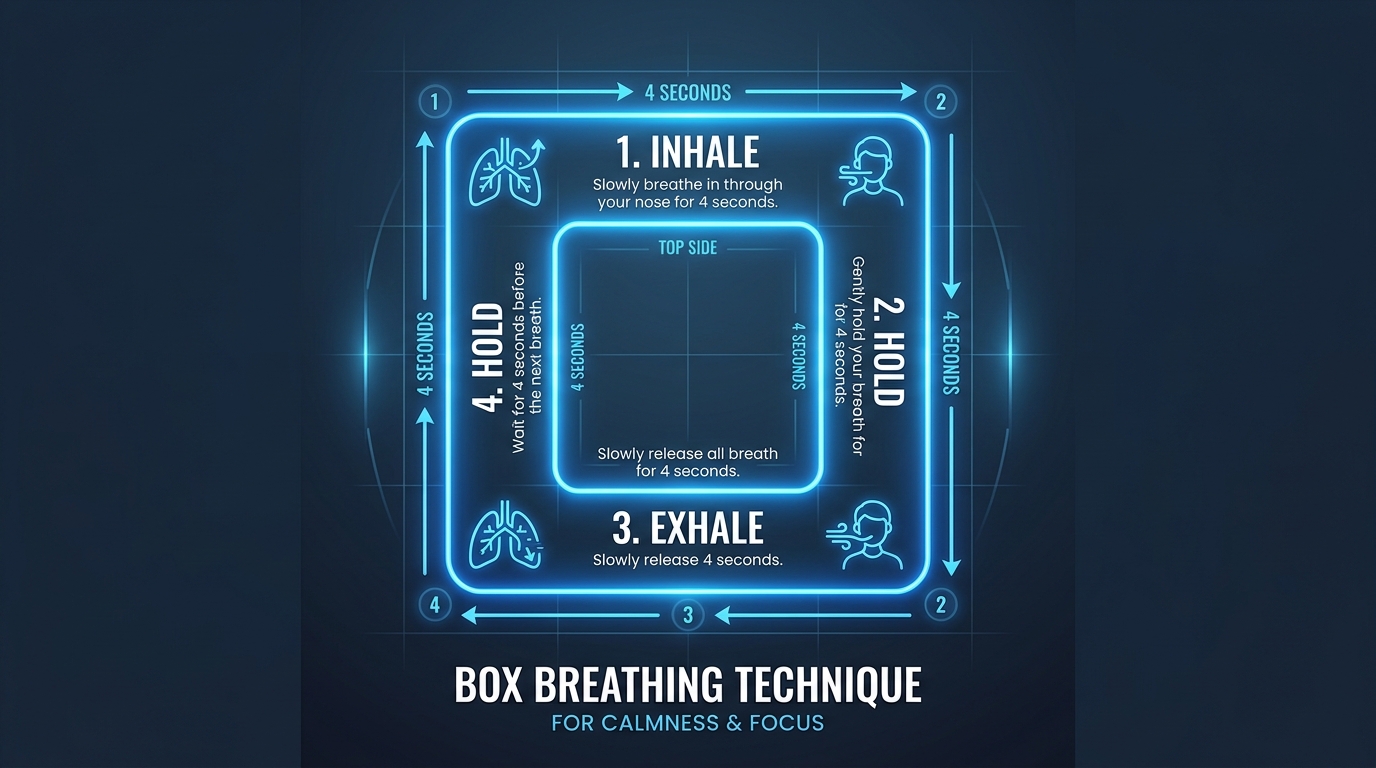
As explored in our guide on the scientific case for box breathing, maintaining an equal ratio between inhale, hold, exhale, and hold stabilizes blood pressure and balances oxygen-carbon dioxide ratios in the bloodstream.
How to Practice the 4-Step Box Breathing Pattern
The mechanics of box breathing are straightforward and highly effective:
- Step 1: Inhale slowly through your nose for 4 seconds, filling your lungs completely.
- Step 2: Hold your breath gently at the top for 4 seconds without straining.
- Step 3: Exhale smoothly through your mouth for 4 seconds, releasing all air.
- Step 4: Hold your lungs empty for 4 seconds before beginning the next cycle.
Repeating this cycle for just two to four minutes acts as a physiological reset button. According to research from the National Institutes of Health (NIH), controlled rhythmic breathing improves heart rate variability (HRV) and enhances cognitive clarity.
Integrating Tactical Breathing into Your Workflow
Practicing box breathing before difficult conversations, complex tasks, or public speaking transforms nervous energy into focused calm. By anchoring your attention to the rhythm of your breath, you build long-term emotional resilience.
To learn more about present-moment practices, visit StillWave Home or explore the StillWave Blog.